
The Future of Education with AI
Expanding & Adding to Zach Stein's New Education Model to Solve the sensemaking and capability crisis for the next 100 years

In my last post What the Future of the Liberal Arts Education Will Look Lik, I outlined and expanded on Zak Stein’s vision. Let me now offer an in-depth solution to our metacrisis in education.
My thesis, blending the work of Stein (from my previous post above), and Fischer & Bidell: We need a hybrid model with AI supporting and co-constructing with humans a new mental model of education embedding the 4 quadrants of integral theory, fostering improved ways of learning and interacting with complex measurements.
Fischer (2006) mentions that we evaluate and continue to view all skills, knowledge, understanding, and human development under the scope of the ladder as our mental model. We accumulate things and can either move up, down or remain inert – only in a linear fashion.
Since all human growth progresses rigidly under this model, some will manage to climb the ladder at higher levels, and others not if they cannot adapt to the ladder (how the content is taught, if it matches their skill levels, etc.). If they can't ascend, then they will be deemed unfit to continue their development and, therefore, doomed to remain unskilled in that subject or pursuit.
Plus, every skill is one ladder with no other scaffolding to support it. What’s the connection between ladders, and do we evaluate all ladders that need to climb? Holding onto this mental model that underpins our educational systems is a misguided, reductionist, and inaccurate conception of development/skill building.
Before we can ascribe a new mental model to education, Fischer & Bidell (2006) lay the prerequisites for what the model must capture. It is directly in line with integral theory as they describe human development (quadrant 1) as a 4-quadrant endeavor.
“(1) to describe basic structures or organizations of activities in context and
(2) to characterize how those structures vary as a function of changes in key dimensions of person, body, task, context, and culture.
Whether the focus is on knowledge, action, emotion, social interaction, brain functioning, or some combination, the dynamic structural approach puts the person in the middle of things and frames the person’s activity in terms of multiple components working together. The maturity or complexity of people’s behavior varies widely and systematically from moment to moment and across contexts, states, and interpretations or meanings. Each individual shows such variations, in addition to the wide variations that occur across ages, cultures, and social groups.” (p. 316)
So what is the new mental model of education we need to adopt for the dynamic structuralism of a 4-quadrant development?
The “Mental” Model
The metaphor – which we discuss in this thread as synonymous terminology to a mental model – Fischer & Bidell 2006 suggest and use in their experimental research is a web (Fischer & Bidell 2006). A web allows for a diverse network of edges combining to form new entities moving in space and time which connect and get entangled. We can think of it also as a mental model of a complex and dynamic system. Here are the authors for further elaboration on the dynamic nature and use of the web:
“The metaphor of a web is useful for dynamic models because it supports thinking about active skill construction in a variety of contexts and for diverse variations. Unlike the steps in a ladder, the strands in a web are not fixed in a determined order but are the joint product of the web builder’s constructive activity and the supportive context in which it is built (like branches, leaves, or the corner of a wall, for a spider web). The activity of an agent in constructing a web is particularly clear.” (p. 319)
The web is not just metaphoric.
It does not remain in the abstract: a web is how learners develop, occurring within a mix of integral quadrants incorporated into the web. The branches, leaves, or other vectors impacting development represent a holistic approach and the true dynamic nature of learning. The web is abstract and deeply tied to the physical, as all mental models are. But what exactly are the physical components of this web?
Strands build the webs that represent the grouping of behaviors, actions, and abstractions that form skills (please also note I will use skills and development interchangeably)(Fischer & Bidell 2006). The groupings of skills vary depending on the context, observation level, and skill scrutinized. The greater the complexity, the more strands will illustrate groupings of skills, and for lower-level skills, the groupings may consist of 1 or 2 skills. Zooming in and zooming out on a strand evaluated will represent different skills.
The web constructs development in a multivariate model wide array of intersecting vectors. Ultimately, you can find how each individual builds the relations of their skills for new skills in set contexts, therefore creating groupings of skills forming strands that lead to development. As a result, each learner can weave their web optimally by how they want and what is most efficient for them.
We can even determine the variables that lead to optimal and functional development for each learner – finding those branches and leaves that lead to subpar results vs high performance (Fischer & Bidell, 2006).
As a result, fairness becomes the foundation of education and can facilitate learning if channeled correctly, thus also improving efficiency. Here is Kischer & Bidell (2006) on the learning possibilities of a dynamic web structure individualized for learners:
“This map of alternative pathways suggests a different remedial educational strategy. Instead of attempting to speed up development in poor readers, teachers can help channel children following divergent pathways into alternatives that converge on the goal of skilled reading (Fink, in press; Wolf & Katzir-Cohen, 2001). By providing environmental support, teachers can channel development, building bridges from the known to the unknown instead of providing frustrating repetitive encounters with the unknown. This approach is being realized most fully in educational efforts for children with learning disorders and handicaps (Fischer, Bernstein, & Immordino-Yang, in press; Rose & Meyer, 2002) and also in some work with maltreated and aggressive children (Ayoub & Fischer, in press; Kupersmidt & Dodge, 2004; Watson, Fischer, & Andreas, 2004). From this perspective, the tool of mapping alternative developmental pathways is especially important for the study of development among children of differing socioeconomic groups, cultures, ethnicities, or races, and children with learning or psychological disorders.” (p. 335)
As you may begin to notice, the web metaphor and its actual use offer many possibilities to improve learning which I will discuss later in this post.
But first, we need to touch upon this question: if we allow for variability in development, then how can we measure everyone similarly?
Dynamic Skill Theory: Capturing Variation with a Common Scale
Fischer and Bidell (2006) use the measurement of temperature as an analogy to explain how variability can be captured for every learner:
“Think of temperature, for which physicists discovered a common scale over the last several hundred years. The same scale can be used to measure the temperature in the sun, Antarctica, a refrigerator or furnace in New York, a person’s mouth, or the bottom of the ocean. Thermometers measure with a common scale across radically different situations and methods, even with great differences in the ways that heat and cold occur.” (p. 323)
How you move up or plateau on the scale is multifaceted, always context-dependent, and influenced by all quadrants of integral theory, but it is a progression towards the same skills.
Skills and the Scale
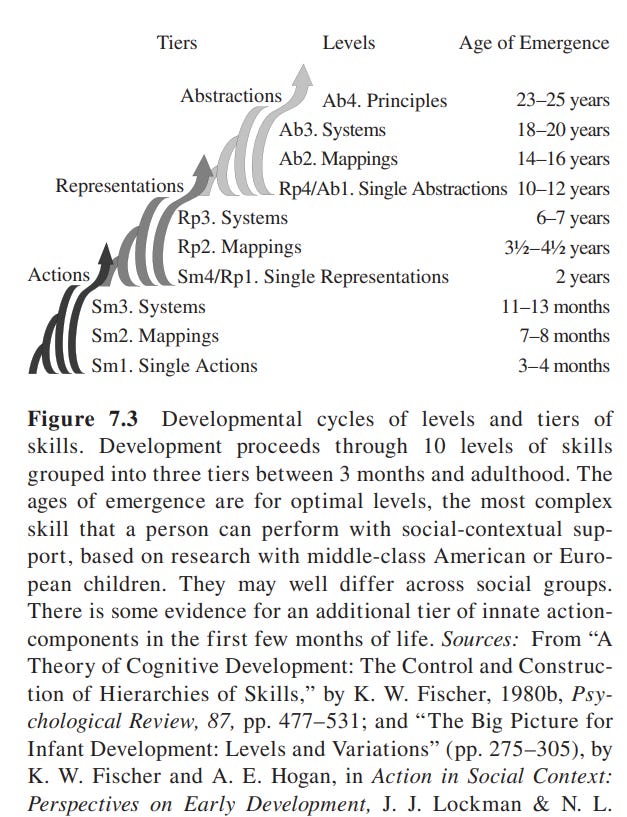
To illustrate the scale, I’ll explain the first tier, the Action Tier, tied to an example followed by a detailed overall structure of the Dynamic Skill Theory scale.
The most rudimentary of all skills is a level 1 set in the Action Tier which is simply 1 sensorimotor skill (Fischer, 1980). It is called a set since it is analogous to a container, a variable. I mention rudimentary because a level 1 sensorimotor skill is associated with the development of children starting at 3 or 4 months of age (Fischer, 1980).
To get to level 2, the mapping, single actions are combined to form new actions (usually 2 sensorimotor actions combined into a new higher level one) (Fischer & Bidell, 2006). Afterward, achieving a level 3 skill is always a bit trickier because to build a system of sensorimotor actions, one requires to combine subsets of sensorimotor action mappings in new ways (Fischer & Bidell, 2006).
The quantum leap happens at level 4. This is when sensorimotor action systems are connected to other sensorimotor action systems, leading to a system of systems (Fischer & Bidell, 2006). When this occurs, they traverse their current tier into the next tier (Fischer & Bidell, 2006). In this instance, the learner would now gain a level 1 skill in the Representational Tier (notice throughout how the development follows the web metaphor)(Fischer & Bidell 2006). Level 4 is always the level 1 of the next tier, hence why level 4 does not show on the diagram.
Skill Development: Action Tier Example
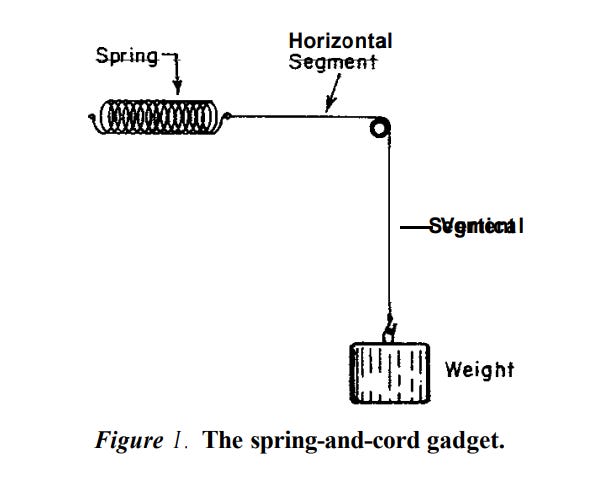
Now let’s explore the example outlined by Fisher and Bidell when a skill development by young children progress (and arguably most adults if sensorimotor skills developed) through the Action Tier to the Representational Tier. As you can see from the image above, this gadget is a spring with a cord wrapped around a nail with a weight below.
At level 1 in the Action Tier, for instance, a skill could be looking at the gadget and grasping it. A mapping, or level 2 skill, could be grabbing and pulling the gadget (Fischer, 1980). At level 3, the child starts to do different movements, such as pulling it to stretch it in different ways for different stretches (Fischer 1980).
An understanding emerges that sensorimotor actions in concert with each other can lead to different physical outcomes depending on the interplay of the actions (sensorimotor action systems)(Fischer, 1980). At this level, it is important to note that the child does not think independently about the gadget: it only functions for them if they act upon it (Fischer, 1980). There is no abstraction, yet.
Then comes the jump at Level 4 to create the Level 1 representation: the child understands that the spring stretches or that the weight makes the vertical line longer independent of their physical involvement with it (Fischer, 1980). The stretching and the weight vertical line shifts are both a system of sensorimotor action systems that no longer require the child’s direct involvement to know the relations. When you have developed a system for something, you don't need your direct sensorimotor actions to know cause-and-effect relationships.
Hence, they can control, for instance, in their mind that a weight change directly causes a vertical line change and thus can think independently of the gadget. Their first abstraction emerges from this understanding, and they leap into the Representational Tier at Level 1.
The Common Patterns of Skill Development
The development in each tier as you ascend the scale, follows the pattern outlined above: a set, map, system, and a system of systems where the latter creates a new set in a new tier (level 4 aka level 1)(Fischer, 1980). The skill units in each tier are different. Sensorimotor action skills are in the first tier, representations in the second, and abstractions in the third.
The Difference between the Representational and the Abstraction Tiers
As to shorten the length of this post, here are the distinction units in each tier to clarify the Representation and the Abstraction Tier as their names may be misleading given they are both abstractions:
Tier 2: Representational Set
“These representational sets designate concrete characteristics of specific object events, or people (including the child he self).” (Fischer, 1980, p.487)
Tier 3: Abstract Level
“the combinations of representational sets create new sets of another kind: abstract sets, which are generalized intangible attributes of broad categories (objects, events, or people).” (Fischer, 1980, p.487)
For further clarification with a concrete example, here is an abstraction in the gadget example:
“Consider a 15-year-old boy who can control a system of systems for the sets in the spring-and-cord gadget. He can integrate several of the systems from the previous level into a single Level 7 (level 1 Abstraction Tier) system that controls the relations among the weight, the vertical length of the cord, the horizontal length of the cord, and the length of the spring. When he is thinking, for example, about how the changes in weight produce changes in the length of the spring, he can simultaneously consider how those changes relate to the changes in the vertical and horizontal lengths of the cord, He can thus understand how all the changes covary. This skill not only allows him to control the gadget effectively, but it also gives him an abstract set for the general state of the gadget.” (Fischer, 1980, p.495)
The Web, Scale & Measurement
Put simply: the scale measures the development of a web -- the latter is the independent variable, and the former the dependent one. Despite perceiving learning as a metaphoric and actual dynamic web allowing for variability in each person, all skills have set levels and tiers to achieve – they are fixed.
For the gadget example, levels in the Action Tier must be achieved before representation level skills, and the latter is the rite of passage to abstractions depending on the skill sought. It is the reason the levels and tiers are associated with ages because mental faculties must develop to move towards higher levels of development. Yet, how one chooses to develop sets, maps, systems, and systems of systems through their web is entirely in their hands.
Measurement and grading wouldn’t be completely divorced from current methods (think learning math where answers are right or wrong), but rather it becomes more about finding someone’s web, observing if they achieved the levels required for the skill through the scale, and evaluating the factors of performance based on these variables. Taking these into account, we can differentiate functional and optimal performance factors, and therefore, have at minimal, 2 grades for each student.
The beauty of the Dynamic Skill Theory and the dynamic web construct is it facilitates measurement transcending traditional methods: we can find strands from other leaves, branches, other contexts, and the levels that are deficient or absent. This then allows the teacher to evaluate if a deeper dive is required in a strand to unpack the granular skill composition or introduce new strands from other domains or sections of the quadrants of integral theory.
Measuring becomes multidimensional and permits the extensification (across quadrants or spread wider within quadrants) and/or intensification of learning paths.
You can see where I’ll be going with this in the AI section, but first a short digression, but those who want the AI ideas for education can skip it and go to the next section about AI!
Is this Model Accurate?
Some of you may still be questioning the validity of the Dynamic Skill Theory. I’ll admit my literature review of human and child development rested on two papers by Fischer and Bidell (a literature review is a generous name). Yet their work rests on experimental research and research founded on others before them (for instance, relying on Piaget's work), and also echoes those of other theorists in a conversation I and others had on metaphoric thinking.
When I asked an acquaintance about if abstractions can detach from the physical, he cites Steven Pinker and Ian McGhilist confirming the hierarchy of the scale:
Me: “or can we go beyond this and move towards more abstract notions without perceptions as a starting point?”
Acquaintance:
“You would love the investigation of this in Steven Pinker’s The Blank Slate, who says that some abstractions, like those involving certain aspects of the structure of languages, come pre-wired, in the form of our intellect, before perceptions. Also:
Something notices patterns in the input it receives, combines them with patterns learned at other times, uses those combinations to scribble new thoughts, and uses them to guide behavior toward goals” (sounds awfully like a web, mappings, systems, and systems of systems doesn’t it?)
Acquaintance Sent Me:
“Another book, The Matter With Things by McGilchrist:
suggests that metaphors are needed to think because nothing is known without understanding it in terms of something else.
“Those something else in the language eventually come back to bodily experiences” p. 632.
Why?
Because bodily experience is all that we have that is concrete, whole, real, and is therefore fundamental to understanding
So What?
“All understanding, at the bottom, is a metaphor” because it connects thoughts with experience p. 632 [[The Matter with Things: Our Brains, Our Delusions and the Unmaking of the World]].
So, “Metaphor embodies thought and places it where it belongs, in a living context” p. 633.”
Metaphors would seem like a method to rapidly move around a constructive web and/or facilitate scrutinies into the strands to note the skills composition and levels. As you may recall, and as Fischer & Bidell 2006 stress, developing skills never omit lower levels: they are always integrated. All skills originate from level 1 single sensorimotor actions to lead to the highest of abstractions.
As a result, metaphors (and perhaps analogies depending on the ones used) elevate learning effectiveness by returning down the scale into the Action Tier or moving laterally in the web construct, connecting the known sensorimotor actions (and maybe the Representational Tier, depending on the context) with representational or abstract levels, and finally reemerging rapidly up the scale. You integrate sets in lower levels to strengthen the strands or connect new strands, improving the learner's comprehension and skill set. Metaphors/mental models are a superglue of human development and the foundation of our cognitive abilities.
Web, Scale, Science of Learning & AI: Putting it All Together
Remember the goal of incorporating AI more actively in the future of education?
Fairness and efficiency to improve/accelerate human development in an all-quadrant framework.
As I alluded to above, with the Dynamic Skill Theory and mental model of education changed, you can foster the variability in learning with AI through an individualized curriculum for each learner and personal or group pairings (classrooms) for teachers. Although AI could generate curricula, teachers would also have a hand in guiding students since even the best learners may not know what is good for their development (Stein, 2019, p. 36).
But what would this future concretely look like?
It would incorporate Zak Stein’s vision I outlined in my post above in this thread but with a twist and AI would be designed with 3 principles of representation (learning/teaching methods and measurement), engagement, and action/expression (Meyer, Rose, Gordon, 2014, p.7). There would be in-person and online learning hubs supported by this 3-principle-designed AI.
Representation
In the following, all content generated or facilitated by AI would be designed with the best learning practices and neuroscience of learning the science to increase teaching effectiveness. These ideas may not be possible to implement with AI, so for those more knowledgeable in the field, I strongly encourage your criticisms!
Suggested individualized learning paths based on a learner's web, skill level, interests, and goals through the Dynamic Skill Theory (the individualized curricula mentioned above);
If all the learners' webs are centralized on an online platform, then learning paths could be generated from other similar learners who previously struggled with the same skill or paired with teachers correlated in helping students leap to the next level or tier. The possibilities are endless if AI can track the multidimensional correlations and causations of skills from the web constructs.
Introduce learning paths within a set integral quadrant or from another one.
Auto-generated gamification of content;
Triggering uncertainty in the learners to active neuroplasticity (I haven’t put much thought into how it could be implemented);
AI tools to make content creation faster for teachers;
Visual, auditory, and kinetic generation of content (having all 3 every time is more efficient);
Metaphor and analogy generation based on a learner's web construction;
*Tracking the short-run learning and projecting the long-run growth rate of skill development (not discussed here but can be done as Fischer & Bidell discuss in their paper). This point alone could warrant another post!
Facilitating chunking during learning;
Addition to flashcard systems that introduce new cards once the learner has mastered one and auto-generate new cards to help the learner connect other cards they created in their deck;
Auto-generated meta-cognition questions with critical thinking facilitation to push the learner to reflect/think more deeply about what they have learned (this too may warrant another post for those interested in how to facilitate critical thinking and how a supervised and unsupervised AI model could do this);
Screens randomly shut off for a few seconds when a learner is struggling to force them to close their eyes, allowing the hippocampus to process the information and problem at hand (see Huberman’s podcast);
As discussed with Zak and Artem, students could use (and I believe can already be done) ChatGPT models to create dialogues with figures throughout history (Zak Stein image if you could have an interaction with Socrates);
Maybe far-fetched, but perhaps the content could be reviewed by AI-generated figures. For example, maybe you could have a ChatGPT model design a prompt where Picasso critiques the work of Leonardo Di Vinci (perhaps this could be done currently with the latest model). Then, to augment and not replace teachers, have the students and teachers discuss the answers generated by the model.
Engagement
AI would essentially act like Lunchclub AI to drive physical and online interactions to foster efficient learning. It could connect students, teachers, scientists, and professors and be the focal point for most of the liberal arts (as I described in a previous comment above).
AI could generate recommendations on connections with learners near them with complimentary or overlapping web constructs for similar or related skills. They could also be paired with teachers who effectively teach the levels where they are currently situated and seek to advance.
If the models do track the correlations and causations in each learner's variability in development, the pairing could occur between low-correlated subjects and interest to drive creativity -- novel ideas are often the fruit of connecting unrelated ideas. The hubs could connect disparate learners operating in different quadrants or far apart within a set quadrant.
Here’s my twist to Zak Stein’s model: for the in-person teachings, I would have AI in the hubs to track the web constructs and skill scale of each learner. Perhaps some NLP model could voice or imagery capture (depending on the VAK modes of representations used by the teacher) the progression of the learners during a lesson and display it at the end.
Having such real-time data generation is the fodder for learning pathways and the basis of performance measurement. If computers are not available in a particular hub for a lesson, maybe phones could dispose of the same technology.
We also have to keep in mind variability and acknowledge engagement isn’t necessarily done in groups. If the learner prefers, for instance, to write about what they are learning or even write a song about it, AI could be leveraged for these situations too. This relates to one of the bullet points above where learners would want to engage by playing games that could do so with AI-generated ones.
Action and Expression
Much like the engagement principle, the action/expression one would aim to pair learners with real-life projects and apprenticeships based on their skill composition or desired goals. Multidisciplinary projects would be easier to conduct if web constructs of every learner are available. I won’t dive too much into this point because it would hinge on how the learner wants to take action and express their learning.
Final Thoughts, I Swear!
Although not perfect, this is how I could see a future model of education using AI to promote an all-quadrant consideration of learning. The system could be much fairer and more efficient than our current outdated 20th-century one. However, substantial investments and roadblocks like the feasibility of AI ideas could prevent them from materializing.
Despite it all, I hope there are a few ideas here that some of you reading will pick up and act upon. And for those who want practical steps to facilitate the dynamic web as their mental model of learning or of those of their children, Fischer and Stein have created a non-profit organization with resources to do so. Here’s the link:
https://lecticalive.org/
Please let me know your feedback and the feasibility of this AI-aided model of education (especially measuring with the Dynamic Skill Theory and constructing every learner’s web since it would be tricky to train a model where skill mappings and web construct data may not be abundant)! All constructive criticism would be greatly appreciated.
Thank you!